

Rewrite YOUR Story with Journaling
The Expressive Writing Protocol - A Unique Approach


Have you ever felt stuck in a story that you didn’t choose? A narrative shaped by past experiences, lingering fears, or unresolved emotions? For years, I carried a story I didn’t even realize was mine—a story that influenced my decisions, shaped my relationships, and held me back in ways I couldn’t fully understand.
But everything began to change when I discovered the power of journaling—not just as a habit, but as a transformative practice that helped me take control of my story. One specific approach, known as the Expressive Writing Protocol, made all the difference. In this post, I’ll share how this technique helped me rewrite my narrative and how you can use it to reclaim yours.
Prefer to listen? Check out my customized podcast episode where the Expressive Writing Protocol is discussed and how it can help you rewrite your story:
Want to dive deeper into this transformative practice? Watch my latest video, where I walk you through the Expressive Writing Protocol step by step!
The Stories We Carry
Life is full of moments that shape us. Some inspire us, propelling us forward, while others leave behind invisible marks—lingering pain, fear, or uncertainty that we may not fully understand. These moments often sneak into our daily lives, quietly influencing the way we see ourselves, others, and the world.
I knew I had unresolved issues around rejection and abandonment, but I didn’t know why. They felt like a shadow—a weight I carried without being fully aware of its presence. It affected my confidence, my relationships, and even the way I made decisions.
That’s the thing about these stories—they don’t always announce themselves. Instead, they whisper, nudging us in directions we might not choose if we were fully aware of their power.
To set the tone, listen to this song inspired by the reflective power of journaling:
A Simple, Transformative Practice
Then, I stumbled across a technique that seemed almost too simple to work: the Expressive Writing Protocol. Developed by Dr. James Pennebaker, this approach invites you to write about a meaningful emotional experience for just 15–20 minutes a day over four consecutive days.
This method isn’t just a self-help trend—it’s grounded in decades of research and has been shown to reduce stress, improve mental and physical health, and help people process unresolved emotions. Dr. Andrew Huberman, a renowned neuroscientist and host of the Huberman Lab Podcast, recently dedicated an episode to this very topic. He explored how expressive writing impacts neuroplasticity and emotional resilience, providing a science-backed perspective on why this simple practice works so well.
You can listen to Dr. Huberman’s insights and learn more about the science behind the protocol in his episode:
👉 A Science-Supported Journaling Protocol to Improve Mental & Physical Health
At first, I was skeptical. How could something as basic as writing help me untangle years of unresolved emotions? But I was intrigued enough to give it a try—and what I discovered surprised me.
How the Expressive Writing Protocol Works
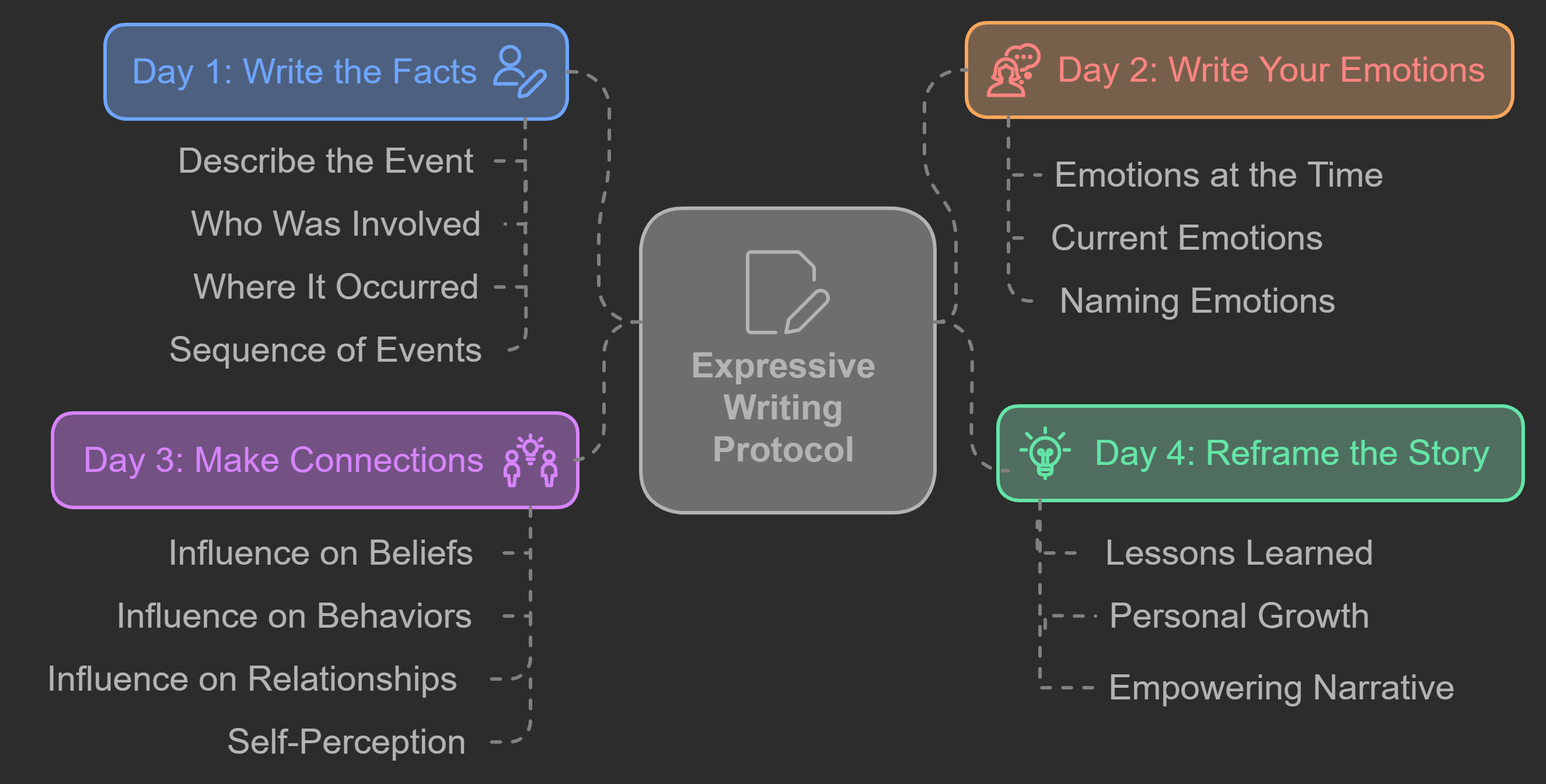
The process is straightforward, but its effects are profound. Here’s how it’s structured:
Day 1: Write the Facts
Start by describing the event as if you’re a neutral observer. Write down what happened—who was involved, where it occurred, and the sequence of events. This step helps you separate the raw facts from the emotions tied to them, creating some distance between you and the experience.Day 2: Write Your Emotions
On the second day, dive into how the experience made you feel. What emotions came up at the time? What do you feel now as you write about it? Naming these emotions is a powerful way to process them. It’s like shining a light on shadows—they lose some of their intensity.Day 3: Make Connections
Here, you explore how this event has shaped other parts of your life. Has it influenced your beliefs, your behaviors, or your relationships? Has it impacted the way you see yourself? Making these connections can uncover patterns and provide clarity about the story you’ve been carrying.Day 4: Reframe the Story
On the final day, you rewrite the narrative. Ask yourself: What did I learn from this experience? How has it helped me grow? What story do I want to tell myself about this event moving forward? This step isn’t about erasing the past—it’s about reframing it in a way that empowers you.

My Journey with the Protocol
When I first tried this process, I chose to focus on a childhood memory that had resurfaced during a moment of self-reflection. It was an experience I hadn’t thought about in years, but as I began writing, I realized how much it had shaped my fears of rejection and abandonment.
Day 1: Writing the facts felt strange at first. It was like taking a mental snapshot of something I’d tried to ignore. But seeing the event on paper, stripped of emotions, gave me clarity.
Day 2: This was the hardest part—acknowledging the feelings I’d buried for so long. Frustration, sadness, even guilt poured onto the page. But as I wrote, those emotions began to feel less overwhelming, like they were finally leaving my mind and settling into the words.
Day 3: I started to see patterns—how this experience had shaped the way I approached relationships and decisions. It was eye-opening, even liberating.
Day 4: The final day was transformative. By reframing the story, I found a sense of peace. That memory, which had felt like a quiet weight, no longer held power over me.

Why This Works
The Expressive Writing Protocol is backed by decades of research. Studies have shown that writing about meaningful emotional experiences can reduce stress, improve mental clarity, and even boost physical health. By putting our thoughts into words, we create a space to reflect, process, and heal. It’s like having a conversation with the truest version of yourself.
How You Can Start
If you’re ready to rewrite your story, here’s how to begin:
Choose a memory or experience that feels unresolved or heavy.
Set aside 15–20 minutes a day for the next four days.
Follow the steps: write the facts, explore your emotions, make connections, and reframe the story.
I’ve created a step-by-step video to guide you through the Expressive Writing Protocol, sharing my personal journey and practical tips.
Closing Thoughts
Journaling isn’t about perfection—it’s about honesty. It’s about giving yourself the space to process and grow. For me, this practice has been transformative, and I believe it can be for you, too.
Your story is yours to tell. It’s yours to rewrite. So, grab a journal, find a quiet space, and take the first step.
Because when you do your best work, you create your best life.

Want to take this journey further? Tune in to my podcast episode where my two friends share deeper insights into the Expressive Writing Protocol:
Your Best Work AI Assistant (You Must Have an OpenAI Account)
I’m excited to introduce Your Best Work AI Assistant, a career and life guidance tool inspired by the principles and strategies I share here on Substack. Whether you’re navigating career transitions, building resilience, or seeking alignment between work and life, this AI-powered assistant is here to help you explore and act on these ideas at your own pace. Talk Directly with Your Best Work AI Assistant